Where behavioral science and humanism get out of the ivory tower, and into the world.

Sunday, February 13, 2011

Watching theory of mind develop over checkers


I spent time with my nephew over the weekend, he's 5 and we just, as of yesterday, taught him how to play checkers.

It was extremely interesting from a psych/cognitive developmental point of view. You could watch him learn a rule, try and apply the rule all the time, and learn its limits. He also practiced taking turns and figure ground discrimination, but that was just the regular stuff.

I got to witness him talking out some of his first experiences with more advanced theory of mind. Theory of mind is the idea that your thoughts are yours alone, and that other people have their own cognitions. Kids take some time to figure this out. That's why really little kids don't tell you that they know where your keys were the whole time. Because they know, they assume you know, and vice versa. It takes some time to figure this isn't the case. The most overt sign of this taking hold is when kids learn to lie. They figure out that they can try and tell you a false hood, and have a chance of not getting caught.

My Nephew started phase two of this recently, modeling other people's thoughts and using them to plan. This is a huge step and is what makes playing games possible. Every time you play checkers, chess, backgammon, poker, etc. You need to take the information in front of you, make your plan, then create a  mental model of what your opponent will do, then modify your plan to take this into account.

He did really well for his first few games of checkers; he ended up being able to predict what would happen about a move ahead of time. 2, and 3 moves is still beyond his grasp but he's on the road.

It's great to see, because this is also a huge factor in developing good relationships. You need to be able to accurately predict what they other person will do in response to what you say or do to/near/with them. Accurate predictions tend to show better functioning which is usually quite nice :-) . It's always great to see people develop themselves, and I gotta say, I take a whole lot of extra pride in seeing my little nephew do it too :-D

Tuesday, December 7, 2010

Mixing modalities

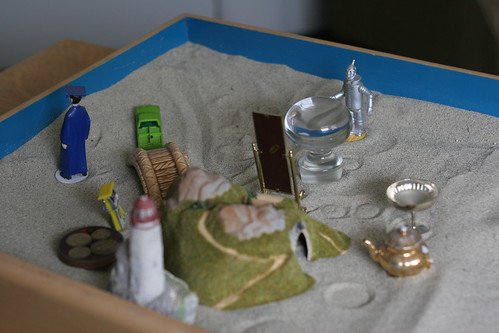
From the Flikr Stream of Emily Hoyer
   
    A little while ago I started getting trained in the fundamentals "Sand Tray" a particular tool of play therapy. It's very interesting and has more in common with art therapy than it does in what people consider "traditional" therapy where people sit around and talk.
    The set up is pretty simple, you have a container roughly the size of a storage bin filled 1/2-3/4 with sand, and a host of miniatures and a mental health professional. From there you essentially let people do what they want. Some people just push the sand around, others make simple, static scenes. Others make highly elaborate dynamic stories that fill, or even overflow from the container. What usually gets created is the person's head space in some way, shape or form.

    It's a very different way to engage with one's mind. Because it's so mailable, and those hard to articulate thoughts can be represented in the tray without words, a whole new way of working with one's inner life is possible. It's accessible for children and adults, average functioning people, those with disabilities and everyone in between.
    I'm really smitten with it :-) . Everyone's welcome to come and try it out!

Thursday, October 14, 2010

Woo! Inflammatory article time!


So Mr. James Oliver at the Guardian has written an article on how current (lack of) genetic evidence for mental illness in populations is strong evidence that much of it is socially constructed, and there for, conservatives are dumb. Ie. Psychological challenges are much more prevalent in people who have a low socio-economic-status as opposed to those who enjoy a high SES regardless of genetic tendencies.

He goes on to talk about how, from a genetic perspective, south east Asia should have the highest rates of depression. While from psych testing it shows to have some of the lowest rates. He goes on to state that this is because they are much more collective society but he doesn’t site any peer-reviewed evidence to support this. Then he goes on to talk about how conservatives are echoing ideas of “Social  Darwinism” in the belief that the genetic sciences would back them up.

While I believe that SES, culture, and environment and quality of learned coping and interaction skills are probably the most important factors in mental health I’m reluctant to take the leap Mr. Oliver did. Correlation / causation are dangerous ideas to conflate, and the ad hominem attacks with it speak to me of major editorializing. Which strikes as a problem when presented in an article that is originally set up to be a fact based one.  

But still… more and more to think about…

Monday, October 11, 2010

It gets better

http://www.itgetsbetterproject.com/


I know I’m a few weeks behind the cutting edge, but I think for everyone who’s not familiar yet with Dan Savages amazing new support idea “It gets better” campaign I thought I’d fill ya in. The main focus is help prevent suicide among teens who identify as part of the LGBTQ community. Many LGBTQ teens commit suicide due to bulling and many other hardships they face as a teen out side the norm. People who identify as LGBTQ, particularly teens, are much much much more likely to use alcohol, other substances, harm themselves and kill themselves.

The youtube channel that he made is filled with videos of adults speaking about their teen years and many of the hardships they faced and that, in fact, life gets better. The bullying ends, they can move to better places, find friends, love and have futures. In hopes that it’ll give strength and solace to LGBTQ youth to make it through. It’s an extremely powerful set of videos and I recommend everyone watch it. Even if you’re not a youth questioning your sexual identity, or knowing that you’re a sexual minority you should watch it, and pass it along to anyone you know who could use some encouragement in life.

http://www.itgetsbetterproject.com/


Sunday, October 3, 2010

New MHCA site!

Hi all!
I just completed and set up the new website for the Hudson Valley chapter of the New York Mental Health Counselors Association. Check it out! http://hudsonvalleynymhca.com

Wednesday, August 11, 2010

Interesting science, misleading reporting.

Science Daily just posted an article reporting on how a group have apparently developed a brain imaging technique to diagnose Autism in adults. This, however, is not really what the article published in "The Journal of Neuroscience" is saying.
I'm really annoyed at the implications that Science Daily is making. To me, their article has a flavor of "Now everyone can get tested!" To me, if you have sensory difficulties, social challenges or other features of Autism-Aspergers that are at a level to be distressing to you, then of course you should seek help. But since there's no real medical cure for ASD (besides one being developed for people with fragile X. And yes I know it's also from science daily, but there have been a few stories about it over the last year or so). So being diagnosed as an adult probably won't do tons for you, other than the relief some people find in having a label for a condition.
Personally I find the real message of the article to be much more interesting. Essentially the researchers found fairly strong evidence that a range of abnormalities in 5 different brain regions seem to be found consistently in people with Autism (sample size was only 20 though, and the control population were people with ADHD) may contribute to autism as a whole. This lends weight to pre-existing ideas that the range in variations in physical neurological abnormalities leads to the cluster of spectrum features that "make up" autism. If anything it helps further research into how these regions working in concert can be distruptive to neuro-typical functioning.

...Just remember, the brain is extremely elastic. People with hydrocephally and people who do not have this condition can have totally different looking brain scans, but have relatively the same functioning and IQ level, it all depends on if/how the brain adapts.

Tuesday, August 3, 2010

I'm a sucker for a good podcast

I just got around to listening to this weeks episode from “The Moth,” an event where people tell true stories on stage live without notes. Over the year or so I’ve been listening I’ve heard stories about people who think they were being haunted, doctors trying to save lives, famous actresses saying how they went psycho on ex-boyfriends. This weeks was particularly striking to me as it focused on a man talking about a Cambodian woman’s experiences during and after the Khmer Rouge. After surviving the atrocities she played a major role in helping a large number of women with PTSD who had seemingly entered a vegetative depression once they reached the relative safety of refugee camps. She spoke about a three-part method for this. Helping people speak about their experiences and letting them learn to “forget” so they could move on, having them do life skills so that they could feel some accomplishment, purpose and maintain themselves more. Lastly, she taught them to do manicures and pedicures. She did this she says so they could have physical contact with others again, and learn to trust and build a community. It’s very interesting to me how universal particular types of responses are to particular types of events, and how often the “treatments” are really focused on community building, rapport building, and allowing people the space to derive meaning from their lives. It seems like I’d be put of the job pretty quickly with some social reforms :-)