Thursday, March 1, 2012
"Many people with severe anxiety and/or depression are also anti-authoritarians. Often a major pain of their lives that fuels their anxiety and/or depression is fear that their contempt for illegitimate authorities will cause them to be financially and socially marginalized; but they fear that compliance with such illegitimate authorities will cause them existential death."
I just read this piece why anti-authoritarians are diagnosed as mentally ill/ and I think it's fantastic. I think it describes numerous people I've worked with as well. I'm very happy that Dr. Levine has written it so well. I think it comes across too in even smaller ways. I've worked with many kids who their main problem seems to be that other people feel they have problems because they're a little quirky on eccentric and then end up internalizing this message of being broken to a huge degree, or fight it fiercely and get all the flack that comes along with it.
My solution? Support the people in their core selves, while teaching them the skills the need to get along at the same time.
Go show some love to your anti-authoritarian friends and family!


Tuesday, November 15, 2011
Woo! New Office Space for me!
Hi all!
Long time no post :-) . I've been very busy lately, but I am pleased to announce the opening of my brand new office space in Larchmont! It's a beautiful space had lots of room for play therapy, sandtray and regular talk therapy. Tell all your friends to come visit me and check it out. :-D Here's a google maps link to it. For some reason google thinks my office is at 1967 plamer, when it's clearly at 2039... who knows why
View Larger Map
Long time no post :-) . I've been very busy lately, but I am pleased to announce the opening of my brand new office space in Larchmont! It's a beautiful space had lots of room for play therapy, sandtray and regular talk therapy. Tell all your friends to come visit me and check it out. :-D Here's a google maps link to it. For some reason google thinks my office is at 1967 plamer, when it's clearly at 2039... who knows why
View Larger Map
Thursday, July 21, 2011
Health insurance for people with low income does a huge amount of good.
A recent scientific article covered by the NYT shows how having access to affordable health insurance, in this case Medicaid, improves people's lives. It a "duh" article, but it's the first of its kind, because they were able to match SES and region and have a true control group. They found that when people have health insurance not only get more emergent care, but they get more preventative care, and have lower stress levels as well.
If you've never experienced the kind of challenges that being on the lower end of the income spectrum brings (or haven't been there for a while) you might want to check out this game http://playspent.org/ . It's amazing how well they made it fit so many life scenarios and how quickly it sets up the stress and anxiety that goes along with just making it.
If you've never experienced the kind of challenges that being on the lower end of the income spectrum brings (or haven't been there for a while) you might want to check out this game http://playspent.org/ . It's amazing how well they made it fit so many life scenarios and how quickly it sets up the stress and anxiety that goes along with just making it.
Friday, April 29, 2011
Major pharmacology companies cutting back on psychtropic research
According to the podcast from Science, a few of the larger drug companies are doing large cut backs on CNS drugs (which includes meds for mental health) siting that they cost the most to develop, take the longest, and are the least likely to get FDA approval. This is fairly significant as there's a fairly limited amount of ways currently to treat mental health problems chemically, and their efficacy varies greatly between people and particular challenges. What remains to be seen is how the gap between need, and supports available will be filled, as many insurance companies seem to want to keep their panels closed, the public clinic's are running over capacity and many in need cannot afford private pay (one of the main reasons I like working for myself, so I can do sliding scale so I can see people with need if I have appointments times open) .
Thursday, April 28, 2011
Alternative forms of thinking, education and adhd,
Most of the ideas in this video have been around for a long long time. The idea that the standard school's model of prepping people for factory work is very outdated, that intelligence as it's currently tested doesn't really measure much and that ADHD while existing in some cases (I worked with a kid who has so little ability to focus he got distracted from being sad about 15 seconds after another kid hurt him pretty badly) but that by and large it's a false epidemic. But he puts it all together very nicely in a very engaging package. Enjoy!
Wednesday, April 13, 2011
Friday, April 1, 2011
Because I'm quite nerdy
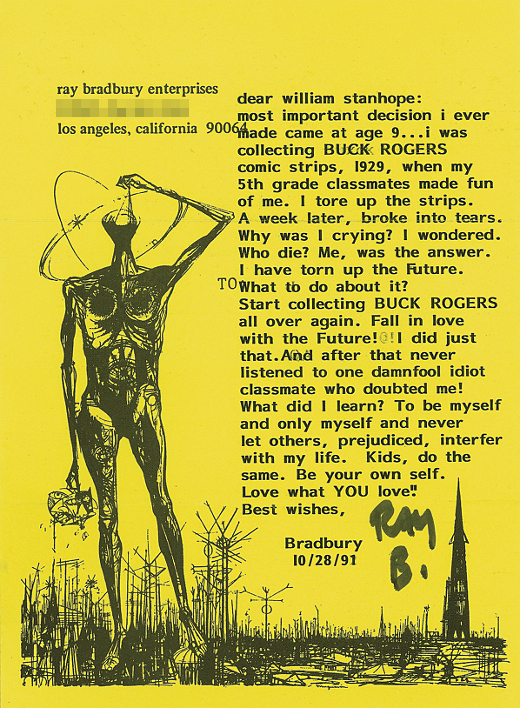
I love Bradbury, Asimov, Phillip K. Dick, and many others. I think this, in it's own way, captures the experience that many people I see have. Come feeling like the first part, leaving like the second. :-)
Wednesday, March 2, 2011
Sunday, February 13, 2011
Watching theory of mind develop over checkers
I spent time with my nephew over the weekend, he's 5 and we just, as of yesterday, taught him how to play checkers.
It was extremely interesting from a psych/cognitive developmental point of view. You could watch him learn a rule, try and apply the rule all the time, and learn its limits. He also practiced taking turns and figure ground discrimination, but that was just the regular stuff.
I got to witness him talking out some of his first experiences with more advanced theory of mind. Theory of mind is the idea that your thoughts are yours alone, and that other people have their own cognitions. Kids take some time to figure this out. That's why really little kids don't tell you that they know where your keys were the whole time. Because they know, they assume you know, and vice versa. It takes some time to figure this isn't the case. The most overt sign of this taking hold is when kids learn to lie. They figure out that they can try and tell you a false hood, and have a chance of not getting caught.
My Nephew started phase two of this recently, modeling other people's thoughts and using them to plan. This is a huge step and is what makes playing games possible. Every time you play checkers, chess, backgammon, poker, etc. You need to take the information in front of you, make your plan, then create a mental model of what your opponent will do, then modify your plan to take this into account.
He did really well for his first few games of checkers; he ended up being able to predict what would happen about a move ahead of time. 2, and 3 moves is still beyond his grasp but he's on the road.
It's great to see, because this is also a huge factor in developing good relationships. You need to be able to accurately predict what they other person will do in response to what you say or do to/near/with them. Accurate predictions tend to show better functioning which is usually quite nice :-) . It's always great to see people develop themselves, and I gotta say, I take a whole lot of extra pride in seeing my little nephew do it too :-D
Tuesday, December 7, 2010
Mixing modalities
 | |||||
| From the Flikr Stream of Emily Hoyer |
The set up is pretty simple, you have a container roughly the size of a storage bin filled 1/2-3/4 with sand, and a host of miniatures and a mental health professional. From there you essentially let people do what they want. Some people just push the sand around, others make simple, static scenes. Others make highly elaborate dynamic stories that fill, or even overflow from the container. What usually gets created is the person's head space in some way, shape or form.
It's a very different way to engage with one's mind. Because it's so mailable, and those hard to articulate thoughts can be represented in the tray without words, a whole new way of working with one's inner life is possible. It's accessible for children and adults, average functioning people, those with disabilities and everyone in between.
I'm really smitten with it :-) . Everyone's welcome to come and try it out!
Thursday, October 14, 2010
Woo! Inflammatory article time!
So Mr. James Oliver at the Guardian has written an article on how current (lack of) genetic evidence for mental illness in populations is strong evidence that much of it is socially constructed, and there for, conservatives are dumb. Ie. Psychological challenges are much more prevalent in people who have a low socio-economic-status as opposed to those who enjoy a high SES regardless of genetic tendencies.
He goes on to talk about how, from a genetic perspective, south east Asia should have the highest rates of depression. While from psych testing it shows to have some of the lowest rates. He goes on to state that this is because they are much more collective society but he doesn’t site any peer-reviewed evidence to support this. Then he goes on to talk about how conservatives are echoing ideas of “Social Darwinism” in the belief that the genetic sciences would back them up.
While I believe that SES, culture, and environment and quality of learned coping and interaction skills are probably the most important factors in mental health I’m reluctant to take the leap Mr. Oliver did. Correlation / causation are dangerous ideas to conflate, and the ad hominem attacks with it speak to me of major editorializing. Which strikes as a problem when presented in an article that is originally set up to be a fact based one.
But still… more and more to think about…
Monday, October 11, 2010
It gets better
http://www.itgetsbetterproject.com/
I know I’m a few weeks behind the cutting edge, but I think for everyone who’s not familiar yet with Dan Savages amazing new support idea “It gets better” campaign I thought I’d fill ya in. The main focus is help prevent suicide among teens who identify as part of the LGBTQ community. Many LGBTQ teens commit suicide due to bulling and many other hardships they face as a teen out side the norm. People who identify as LGBTQ, particularly teens, are much much much more likely to use alcohol, other substances, harm themselves and kill themselves.
The youtube channel that he made is filled with videos of adults speaking about their teen years and many of the hardships they faced and that, in fact, life gets better. The bullying ends, they can move to better places, find friends, love and have futures. In hopes that it’ll give strength and solace to LGBTQ youth to make it through. It’s an extremely powerful set of videos and I recommend everyone watch it. Even if you’re not a youth questioning your sexual identity, or knowing that you’re a sexual minority you should watch it, and pass it along to anyone you know who could use some encouragement in life.
http://www.itgetsbetterproject.com/
Sunday, October 3, 2010
New MHCA site!
Hi all!
I just completed and set up the new website for the Hudson Valley chapter of the New York Mental Health Counselors Association. Check it out! http://hudsonvalleynymhca.com
I just completed and set up the new website for the Hudson Valley chapter of the New York Mental Health Counselors Association. Check it out! http://hudsonvalleynymhca.com
Wednesday, August 11, 2010
Interesting science, misleading reporting.
Science Daily just posted an article reporting on how a group have apparently developed a brain imaging technique to diagnose Autism in adults. This, however, is not really what the article published in "The Journal of Neuroscience" is saying.
I'm really annoyed at the implications that Science Daily is making. To me, their article has a flavor of "Now everyone can get tested!" To me, if you have sensory difficulties, social challenges or other features of Autism-Aspergers that are at a level to be distressing to you, then of course you should seek help. But since there's no real medical cure for ASD (besides one being developed for people with fragile X. And yes I know it's also from science daily, but there have been a few stories about it over the last year or so). So being diagnosed as an adult probably won't do tons for you, other than the relief some people find in having a label for a condition.
Personally I find the real message of the article to be much more interesting. Essentially the researchers found fairly strong evidence that a range of abnormalities in 5 different brain regions seem to be found consistently in people with Autism (sample size was only 20 though, and the control population were people with ADHD) may contribute to autism as a whole. This lends weight to pre-existing ideas that the range in variations in physical neurological abnormalities leads to the cluster of spectrum features that "make up" autism. If anything it helps further research into how these regions working in concert can be distruptive to neuro-typical functioning.

...Just remember, the brain is extremely elastic. People with hydrocephally and people who do not have this condition can have totally different looking brain scans, but have relatively the same functioning and IQ level, it all depends on if/how the brain adapts.
I'm really annoyed at the implications that Science Daily is making. To me, their article has a flavor of "Now everyone can get tested!" To me, if you have sensory difficulties, social challenges or other features of Autism-Aspergers that are at a level to be distressing to you, then of course you should seek help. But since there's no real medical cure for ASD (besides one being developed for people with fragile X. And yes I know it's also from science daily, but there have been a few stories about it over the last year or so). So being diagnosed as an adult probably won't do tons for you, other than the relief some people find in having a label for a condition.
Personally I find the real message of the article to be much more interesting. Essentially the researchers found fairly strong evidence that a range of abnormalities in 5 different brain regions seem to be found consistently in people with Autism (sample size was only 20 though, and the control population were people with ADHD) may contribute to autism as a whole. This lends weight to pre-existing ideas that the range in variations in physical neurological abnormalities leads to the cluster of spectrum features that "make up" autism. If anything it helps further research into how these regions working in concert can be distruptive to neuro-typical functioning.

...Just remember, the brain is extremely elastic. People with hydrocephally and people who do not have this condition can have totally different looking brain scans, but have relatively the same functioning and IQ level, it all depends on if/how the brain adapts.
Tuesday, August 3, 2010
I'm a sucker for a good podcast
I just got around to listening to this weeks episode from “The Moth,” an event where people tell true stories on stage live without notes. Over the year or so I’ve been listening I’ve heard stories about people who think they were being haunted, doctors trying to save lives, famous actresses saying how they went psycho on ex-boyfriends. This weeks was particularly striking to me as it focused on a man talking about a Cambodian woman’s experiences during and after the Khmer Rouge. After surviving the atrocities she played a major role in helping a large number of women with PTSD who had seemingly entered a vegetative depression once they reached the relative safety of refugee camps. She spoke about a three-part method for this. Helping people speak about their experiences and letting them learn to “forget” so they could move on, having them do life skills so that they could feel some accomplishment, purpose and maintain themselves more. Lastly, she taught them to do manicures and pedicures. She did this she says so they could have physical contact with others again, and learn to trust and build a community. It’s very interesting to me how universal particular types of responses are to particular types of events, and how often the “treatments” are really focused on community building, rapport building, and allowing people the space to derive meaning from their lives. It seems like I’d be put of the job pretty quickly with some social reforms :-)
Sunday, July 11, 2010
Bullies and their victims
Ohh, I love Science daily. It’s like reader’s digest for PsycInfo (I wish I still had access to that, anyone who hooks me up will get a plate of cookies!) …. Anyway… I really like the article they just covered on the correlations between skill sets and bully/victim behavior. Dr. Clayton Cook of LSU did a meta-study on 153 different studies that examined which traits, or lack there of, went a long being a bully or a victim with interesting results. It seems that the main commonalities are that both groups have poor social-problem resolution skills, perform poorly in school, experience social isolation, have negative views of themselves and others, and possibly have challenging homes lives.
A lot of this may fall into a “chicken or the egg” question, but it I think it highlights very important information in how to handle it. Like most American “corrections” policy, a lot of anti-bullying policy focuses on chastisement and isolation of the perpetrator. Nietzsche would probably argue that this mostly does little more than let the victims feel a little schadenfreude (I think spreading activation theory clicked my brain over into German mode…). Instead of suspending a person, which would further isolate them and probably cause more challenges for them in school, wouldn’t it make more sense to view behaviors on both ends as an expression of need? Working on academic and social skill building, hopefully early on, would probably do much for everyone involved. Maybe I’ve read too much Buddhism, but it really does seem that all human cruelty springs from a lacking or pain in one form or another. Solving that seems to me to be the best way to end the cruelties.
A lot of this may fall into a “chicken or the egg” question, but it I think it highlights very important information in how to handle it. Like most American “corrections” policy, a lot of anti-bullying policy focuses on chastisement and isolation of the perpetrator. Nietzsche would probably argue that this mostly does little more than let the victims feel a little schadenfreude (I think spreading activation theory clicked my brain over into German mode…). Instead of suspending a person, which would further isolate them and probably cause more challenges for them in school, wouldn’t it make more sense to view behaviors on both ends as an expression of need? Working on academic and social skill building, hopefully early on, would probably do much for everyone involved. Maybe I’ve read too much Buddhism, but it really does seem that all human cruelty springs from a lacking or pain in one form or another. Solving that seems to me to be the best way to end the cruelties.
Tuesday, July 6, 2010
They might really not understand…
New research by Dr. Dabrowska and James Street summarized by Science Daily sheds interesting light on parts of communication that was until now, seemingly taken for granted.
A lot of linguistic theory assumes that people are hardwired for language (which does seem to have merit) but, Chomsky, and many of his followers argue that there is “fundamental grammar” that all people understand language parts in the same way. There’s been some controversial indications that this might not be true such as the book “Don’t sleep there are snakes” where a missionary to the amazon says he worked with a tribe that doesn’t use recursive language. Which basically means that their language doesn’t allow for sentences that would have two commas in them. Recursion is/was assumed to a part of all human language.
The new research shows that many native adult English speakers may not understand “passive” sentence construction ie. “The soldier was hit by the sailor.” As opposed to “active” sentence construction, “The sailor hit the soldier.” Understanding passive sentences was another aspect of language that was assumed to be a universal. These contrary findings have many implications.
The one that jumps out to me is that co-workers, children, parents and really anyone else you might speak with literally may not understand you, or get the opposite meaning out of your words. Maybe those people who seem to actively contradict others are really trying to please. At the core of this frustrating behavior may actually be the result of incomplete language processing.
It’s simply to get around though, and is used throughout the mental health world. Repeating back the speakers statements in one’s own words allows for corrections to be made, and ensures that both parties are understood.
I still wonder though how many times I’ve been mad at people thinking they want to frustrate me when all it was, was a break down in communication.
A lot of linguistic theory assumes that people are hardwired for language (which does seem to have merit) but, Chomsky, and many of his followers argue that there is “fundamental grammar” that all people understand language parts in the same way. There’s been some controversial indications that this might not be true such as the book “Don’t sleep there are snakes” where a missionary to the amazon says he worked with a tribe that doesn’t use recursive language. Which basically means that their language doesn’t allow for sentences that would have two commas in them. Recursion is/was assumed to a part of all human language.
The new research shows that many native adult English speakers may not understand “passive” sentence construction ie. “The soldier was hit by the sailor.” As opposed to “active” sentence construction, “The sailor hit the soldier.” Understanding passive sentences was another aspect of language that was assumed to be a universal. These contrary findings have many implications.
The one that jumps out to me is that co-workers, children, parents and really anyone else you might speak with literally may not understand you, or get the opposite meaning out of your words. Maybe those people who seem to actively contradict others are really trying to please. At the core of this frustrating behavior may actually be the result of incomplete language processing.
It’s simply to get around though, and is used throughout the mental health world. Repeating back the speakers statements in one’s own words allows for corrections to be made, and ensures that both parties are understood.
I still wonder though how many times I’ve been mad at people thinking they want to frustrate me when all it was, was a break down in communication.
Thursday, May 13, 2010
Who saw this one coming?
So, remember how that health reform bill got passed and a lot of stuff got gutted from it as a concession to the health insurance industry? I guess it wasn’t enough. I had heard through the grape vine of a few instances where insurance companies were acting like they weren’t up to speed with the new regulations. Looks like what’s really happening is they’re trying to get around a whole bunch of laws.
Quick history lesson for those of you who’ve never really dealt with mental health managed care. Insurance companies treat mental health and physical health very differently. You can go to an M.D. as much as you want, stay in a hospital for as long as medically necessary and the health insurance folk don’t have too much say in it. In the mental health and addiction recovery worlds however, there are session limits, need for continuing care requests, pain in the butt treatment plans and all kinds of crazy different co-pay rates which don’t exist in the M.D. side of insurance.
This causes problems because therapy isn’t like going to the doctor for an annual checkup and maybe a follow up a few weeks later when the tests come back. Therapy is usually a weekly visit, and it often takes a few months. I used to work for a site that only could provide ultra-brief therapy with an 8 session limit. People usually don’t get really into the really deep parts of therapy until session 5 or 6 anyway.
The new laws passed as part of the bill say that physical and mental health insurance needs to work the same. So if you have unlimited M.D. visits, you also get unlimited visits with a mental health worker, same co-pays etc.
The insurance companies don’t like that their profit margins would lower a little as a result of having to cover cost of care for people. So it looks like from this article that many insurance companies are trying to back slide and continue not to provide adequate levels of mental health care. Guess I’m just a little bitter about the whole thing. Still, I strongly encourage everyone to call their representatives, and let them know if you feel this is a problem. Hopefully with enough noise they’ll stand up to the companies for us and require them to do what is expected of them: To cover the cost of health needs.
Quick history lesson for those of you who’ve never really dealt with mental health managed care. Insurance companies treat mental health and physical health very differently. You can go to an M.D. as much as you want, stay in a hospital for as long as medically necessary and the health insurance folk don’t have too much say in it. In the mental health and addiction recovery worlds however, there are session limits, need for continuing care requests, pain in the butt treatment plans and all kinds of crazy different co-pay rates which don’t exist in the M.D. side of insurance.
This causes problems because therapy isn’t like going to the doctor for an annual checkup and maybe a follow up a few weeks later when the tests come back. Therapy is usually a weekly visit, and it often takes a few months. I used to work for a site that only could provide ultra-brief therapy with an 8 session limit. People usually don’t get really into the really deep parts of therapy until session 5 or 6 anyway.
The new laws passed as part of the bill say that physical and mental health insurance needs to work the same. So if you have unlimited M.D. visits, you also get unlimited visits with a mental health worker, same co-pays etc.
The insurance companies don’t like that their profit margins would lower a little as a result of having to cover cost of care for people. So it looks like from this article that many insurance companies are trying to back slide and continue not to provide adequate levels of mental health care. Guess I’m just a little bitter about the whole thing. Still, I strongly encourage everyone to call their representatives, and let them know if you feel this is a problem. Hopefully with enough noise they’ll stand up to the companies for us and require them to do what is expected of them: To cover the cost of health needs.
Thursday, April 29, 2010
Approximately 321,711,000 Rx’s for psychotropic meds were written last year.
Psychcentral just put up this article, Top 25 Psychiatric Prescriptions, giving a break down of number of prescriptions written for different kinds of psychiatric meds written last year. 9 of the top 10 meds on the list are primarily for anxiety and depression,
I’m not really sure how to interpret these numbers. They’re a lot, and not a lot, and it probably means both good, and not such good things about our society.
Some things to consider off the start are that many people are on more than one med, and on average you need to get your script refilled once every few months. If you break it into the most conservative estimate, lets say that people are taking a cocktail of 3 meds (which would be a pretty high number of meds to be on) and that they get their prescription refilled once a month you’re left you’re left with 8,936,416,67 or roughly 9 million people on medication. One million more people than live in NYC. That is a pretty sizeable number of people to have on meds, but it’s a lot lower than the number of people suffering form a mental disorder in a given year according to NIMH. They say they’re basing their numbers on the WHO estimates, but I wasn’t able to find out how they’re basing their numbers.
So how can you look at this? The upside is probably that the stigma of taking meds has significantly decreased, so more people who need help are likely to seek it out. At the same time, what does this mean about the kind of social and psychological conditions that our society lives under? The meds in the top 10 really aren’t targeting things like delusions, hallucinations, mania, or anything like that. They’re for people who feel sad and worried.
Depression and anxiety do have chemical basis, but they’re also strongly affected by the kinds of social contact, supports and coping skills people have, where things like schizophrenia and mania which are much less driven by social contact. It doesn’t really matter how good you are at handling life and how many true friends you have when you KNOW that the tv is sending you coded messages about how you’re the next messiah.
The hypothesis that rings truest for me (as opposed to its acceptance, marketing, increased genetic predisposition, etc.) is that maybe our society is currently not set up to provide the right kinds of social interactions that people need, or that no ones thinks they should be distressed as an indication that an important event has happened or something is amiss in their life. I think about how many people I interact with in the world at large that are mostly motivated by fear, which spins into isolation, in both knowing others, and knowing one’s self. In my experience as a counselor having both of kinds of knowledge are key to finding one’s way out of depression and anxiety in the long run, and maybe with the help of some good psycho-pharmacology.
I’m not really sure how to interpret these numbers. They’re a lot, and not a lot, and it probably means both good, and not such good things about our society.
Some things to consider off the start are that many people are on more than one med, and on average you need to get your script refilled once every few months. If you break it into the most conservative estimate, lets say that people are taking a cocktail of 3 meds (which would be a pretty high number of meds to be on) and that they get their prescription refilled once a month you’re left you’re left with 8,936,416,67 or roughly 9 million people on medication. One million more people than live in NYC. That is a pretty sizeable number of people to have on meds, but it’s a lot lower than the number of people suffering form a mental disorder in a given year according to NIMH. They say they’re basing their numbers on the WHO estimates, but I wasn’t able to find out how they’re basing their numbers.
So how can you look at this? The upside is probably that the stigma of taking meds has significantly decreased, so more people who need help are likely to seek it out. At the same time, what does this mean about the kind of social and psychological conditions that our society lives under? The meds in the top 10 really aren’t targeting things like delusions, hallucinations, mania, or anything like that. They’re for people who feel sad and worried.
Depression and anxiety do have chemical basis, but they’re also strongly affected by the kinds of social contact, supports and coping skills people have, where things like schizophrenia and mania which are much less driven by social contact. It doesn’t really matter how good you are at handling life and how many true friends you have when you KNOW that the tv is sending you coded messages about how you’re the next messiah.
The hypothesis that rings truest for me (as opposed to its acceptance, marketing, increased genetic predisposition, etc.) is that maybe our society is currently not set up to provide the right kinds of social interactions that people need, or that no ones thinks they should be distressed as an indication that an important event has happened or something is amiss in their life. I think about how many people I interact with in the world at large that are mostly motivated by fear, which spins into isolation, in both knowing others, and knowing one’s self. In my experience as a counselor having both of kinds of knowledge are key to finding one’s way out of depression and anxiety in the long run, and maybe with the help of some good psycho-pharmacology.
Wednesday, March 10, 2010
Complexes from complex complexes
I just finished reading “Are Prisons Obsolete?” by Angela Davis and found notes from a few weeks ago on statements that Tom Ricks made on Fresh Air and it got me thinking. First off, these two people might have the most opposite histories you can imagine. Some highlights from Ms. Davis’ past are: ties to the Black Panthers, was nominated twice to run as the vice presidential candidate the communist party, the 3rd woman ever on the FBI’s most wanted list for reasons related to the kidnapping and murdering of a superior court judge, and, you know, a professorship at U.C. Santa Cruze. Tom Ricks on the other hand is a Pulitzer prize winning journalist specializing in military reporting for the Wall Street Journal. He grew up in Scarsdale, NY (my home town) and Afghanistan (not my home town) and is currently a member of a defense policy think tank.
I can hear you asking, where the poop do these two people’s thoughts and ideologies cross, and how on earth could this be related to psychology? I’ll tell you! It’s all about their ideas on the need to reform massive coercion based systems into humanistic systems to actually meet the goals they say they’re reaching for! Ha!
Angela Davis makes a very strong case for illustrating how modern prisons are essentially based off a 100+ year old idea that wasn’t very good to start with and in its continuing incarnations really serves to continue racism, classism and misogyny with its main aim to control minorities and provide cheep labor. Tom Ricks argued that a main problem with the military is that it was currently using strategies based on English and French colonial strategies used to put down uprisings, but maintain the dependence on mother country also for easy control.
What’s the problem with both? Control. As both systems currently stand in opposition to helping people learn better ways to meet their needs. In essence they perpetuate and increase the dissidence that people feel by not listening to the needs they are expressing causing more crime, hatred, and violence instead of making the world a safer place.
Interestingly, both thinkers have very similar solutions to these problems, at least from a humanistic psych perspective. Tom Ricks related an change in style where officers used active listening (he described this psych skill set to a T with out using the words) with the locals which resulted in the people being heard, and a much more successful campaign towards helping them reclaim their country and be less dependent on the U.S. military.
Angela Davis argues that abolishing prisons and using large scale active listening to focus on the social ills that cause crime and solving them work better. Controlling criminal behavior in a cell block does nothing. Going for “reparation instead of retribution” helping violent offenders meet their needs for better social integration, allowing them to make amends, grow and continue on with their life to help the their communities grow which is the core of humanism.
All of this was pretty glib, but really, its pretty powerful to me that both these people, probably without formal training in humanism, have independently come to see it as the answers to such different problems with such different scales.
I can hear you asking, where the poop do these two people’s thoughts and ideologies cross, and how on earth could this be related to psychology? I’ll tell you! It’s all about their ideas on the need to reform massive coercion based systems into humanistic systems to actually meet the goals they say they’re reaching for! Ha!
Angela Davis makes a very strong case for illustrating how modern prisons are essentially based off a 100+ year old idea that wasn’t very good to start with and in its continuing incarnations really serves to continue racism, classism and misogyny with its main aim to control minorities and provide cheep labor. Tom Ricks argued that a main problem with the military is that it was currently using strategies based on English and French colonial strategies used to put down uprisings, but maintain the dependence on mother country also for easy control.
What’s the problem with both? Control. As both systems currently stand in opposition to helping people learn better ways to meet their needs. In essence they perpetuate and increase the dissidence that people feel by not listening to the needs they are expressing causing more crime, hatred, and violence instead of making the world a safer place.
Interestingly, both thinkers have very similar solutions to these problems, at least from a humanistic psych perspective. Tom Ricks related an change in style where officers used active listening (he described this psych skill set to a T with out using the words) with the locals which resulted in the people being heard, and a much more successful campaign towards helping them reclaim their country and be less dependent on the U.S. military.
Angela Davis argues that abolishing prisons and using large scale active listening to focus on the social ills that cause crime and solving them work better. Controlling criminal behavior in a cell block does nothing. Going for “reparation instead of retribution” helping violent offenders meet their needs for better social integration, allowing them to make amends, grow and continue on with their life to help the their communities grow which is the core of humanism.
All of this was pretty glib, but really, its pretty powerful to me that both these people, probably without formal training in humanism, have independently come to see it as the answers to such different problems with such different scales.
Subscribe to:
Posts (Atom)